Endings guide · August 15, 2026 · RT ~3 min
Revenge on Gold Diggers: How the 38 Endings Actually Work
Standard vs Master mode, how 200+ choices compress into ending families, and the efficient way to hunt every ending without replaying 472 minutes.
Updated — August 17, 2026
Revenge on Gold Diggers ships with 38 endings across 472 minutes of live-action footage, the largest branching structure in any commercial FMV, and the reason its Steam forums filled with route-trading threads within days of launch. This guide explains how the system actually works and how to clear it efficiently. A full ending-by-ending walkthrough with exact choice chains is in progress and will be added to this page, timed with the iPhone release.
 Reading the room is the real gameplay: every scene is a test of what you’ve noticed.
The premise, and why it matters for routing
You play a man who infiltrates the world of emotional-fraud schemes, the “pig-butchering” romance cons that have become a global epidemic, learning to recognize manipulation from the inside. That premise isn’t just marketing: it’s the routing logic. The game is a manipulation-literacy machine, and the endings are graded on how well you actually learned to see the con, not on picking the “nice” option.
That’s why first-time players report endings that feel brutally earned: the game was tracking things you didn’t know were tests.
The two modes
- Standard mode is the guided experience: the story keeps momentum even when you misread a situation, steering you through the main dramatic arcs. Think of it as the “theatrical cut” of your choices.
- Master mode is the real examination. Manipulation cues are subtler, wrong reads cost you faster, safety rails come off, and several endings can only be reached here. If you’re hunting completion, most of your hours will be in Master.
Play Standard first. The game’s premise, learning to see emotional manipulation, only lands once, on an unspoiled run, and Master mode assumes you’ve internalized the fundamentals.
How 200+ choices become 38 endings
The decision points aren’t 200 coin flips. They compress through three systems:
- Relationship trust levels. Your consistency with each key character accumulates silently. Many “sudden” endings are actually thresholds you crossed hours earlier, the game remembers who you were, not just what you clicked.
- Evidence and information. What you’ve noticed, and chosen to act on, gates which confrontations even become available. Some routes are invisible until you’ve collected the reads that unlock them.
- Hinge scenes. A minority of choices are true structural switches that commit you to a branch family. These are where the ending count multiplies, and they’re recognizable in hindsight: the scenes where the music drops out and the game makes you sit with the decision.
The practical consequence: endings group into families sharing a hinge, and the efficient hunt is family-by-family, not ending-by-ending.
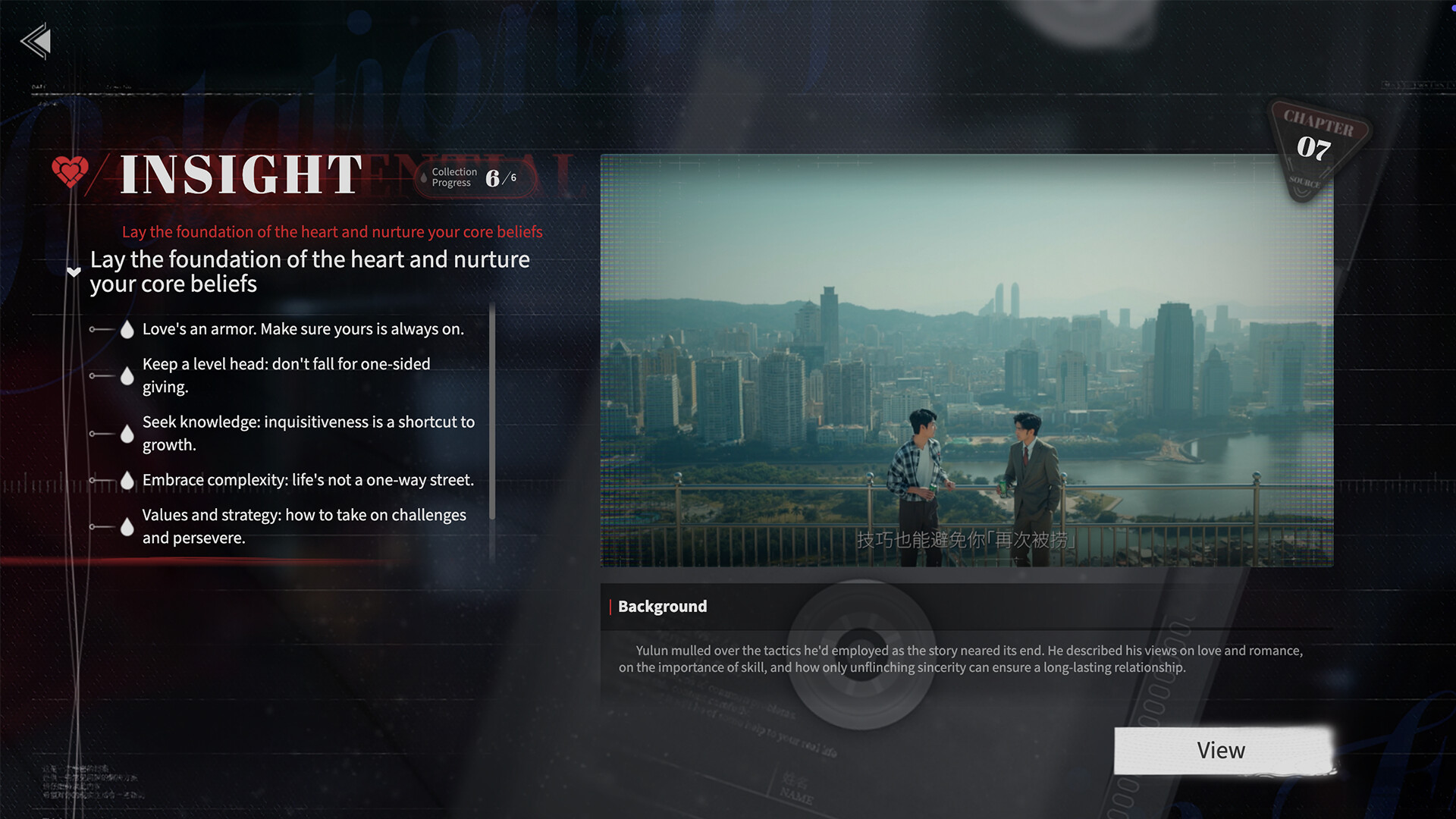 Hinge scenes commit you to a branch family, learn to feel them coming.
Hunting all 38 without losing your mind
- First run: honest, blind, Standard. Choose what you’d actually do. This calibrates you for everything after, and it produces the ending that’s “yours”, the one worth remembering before completionism dissolves the story into a flowchart.
- Then hunt by family. Rewind to the most recent hinge and exhaust its local branch family before moving up the tree. This is dramatically faster than fresh runs: with 472 minutes of footage, route discipline is the difference between a weekend and a month.
- Track trust deliberately in Master. When a branch refuses to open, the cause is usually an accumulated trust level, not the choice in front of you. Go back further than feels necessary.
- Expect the bad endings to be the point. A large share of the 38 are variations of being successfully played. They’re written as lessons, the developers have said the game’s purpose is scam-awareness, and several of the best scenes in the entire production are hidden inside the failure states. Completionists get the richest version of the story.
The bigger picture
The 38-ending structure is unprecedented at this production scale, and it’s the clearest proof of what the Chinese interactive film wave does differently: treat branching not as a gimmick bolted onto a film, but as the film’s actual subject. Our feature on how Chinese interactive films conquered Steam puts the game in context, and the game page tracks the iOS release, where this guide will get its full route maps.